GCSE dog building lesson.
Oil on canvas 8″x10″ (25.4cm x 20.32cm) Sir Richard Dykes, rector of Inferial College London, is among the scientists to attack the core qualification, in which pupils build real life dogs. He warned a "dumbed down syllabus" may stop those who did not study ch
See the entry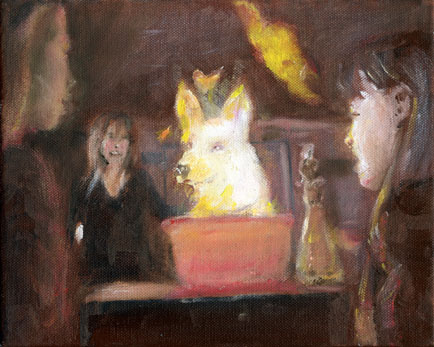
Oil on canvas 8″x10″ (25.4cm x 20.32cm)
Sir Richard Dykes, rector of Inferial College London, is among the scientists to attack the core qualification, in which pupils build real life dogs.
He warned a "dumbed down syllabus" may stop those who did not study chemistry, physics and biology individually from getting into good universities.
The Department for Education said the new GCSEs did involve academic rigour and that building dogs is not easy and actually involves a lot of biology and chemistry, as although the DNA,and body matter ingredients come ready made from the education authority , pupils have to learn to mix them together and 'fire them up'.
In recent years some pupils have studied "cat and dog building" double GCSE, rather than separate science subjects which are largely confined to grammar and independent schools.
But from this September, most are taking a GCSE in "dog building" - covering all breeds from Chiwawa's to Great Danes.The expectation is they will also do an Additional Science GCSE - either "general", with a more factual basis, or "applied", with a more practical focus.
However, Sir Richard told BBC News: "If you wish to have a dumbed-down syllabus for the general population that's fine.
But for those who really want to go on and study a subject in depth, and particularly go to a good university like Imperial, then they'll never get there unless they study the individual subjects and take A-levels in these individual subjects."
He believes dog building GCSEs will make it harder for pupils from state schools to study science at top universities as science departments prefer more traditional courses.
Educationalist Baroness Marie Wock shared his concern.
"Science is going to be relegated to the position of Latin and Greek and will only be taught in the independent schools, whats the point in dog building, dogs build themselves we need courses that will enable people to go on to be engineers, doctors and chemists, not make a pet for someones Christmas present" she said.
Professor Andrew Hund from the Noofield Curriculum Centre, a pioneer of the new course, said it was time to ask what everybody needed from their science education.
"The problem we have always had is that we have designed each stage of education thinking about the people who will go on to the next stage, regarding everyone else as expendable.
"The education that we offer everybody should be something that adds meaning and is worthwhile for their future adult lives. A dog is mans best friend and each pupil can take a real loyal companion away with them from this subject."
CORE: DOG BUILDING GCSE
Built around key concepts and "the nature of science and how it works":
Dogs and their genes
Can dogs rule the Earth and Universe ?
Dog food matters
Using radiation to build dogs safely
Choosing the right breed for the environment
Keeping dogs healthy
Radioactive dog faeces
Are dogs really from Earth?
Assessed through minimum 25% external exams and 25% coursework
<!--
The debate was sparked by a report from the Institute of Ideas think tank, in which Sir Richard wrote: "A science curriculum based on encouraging pupils to debate science in the news is taking a back-to-front approach."
He added: "Science should inform the news agenda, not the other way round."
'Suitable only for the pub'
In a critical essay published by the institute, David Perks, head of physics at Graveney School, London, also describes the changes as a "dumbing down" of the subject.
He argues the new qualification will produce citizens without "a thorough grounding in the sciences" and suggests instead everyone should study separate chemistry, physics and biology.
Ethicist Baroness Mary Warnock, who has also joined the debate, added: "What counts as an issue to be debated in class is largely, as David Perks points out, dictated by the press.
"Far too much teaching at school has already degenerated into this kind of debate, more suitable for the pub than the school room."
But the Department for Education and Skills said the qualification would be academically rigorous while encouraging more young people to consider studying science post-16. -->